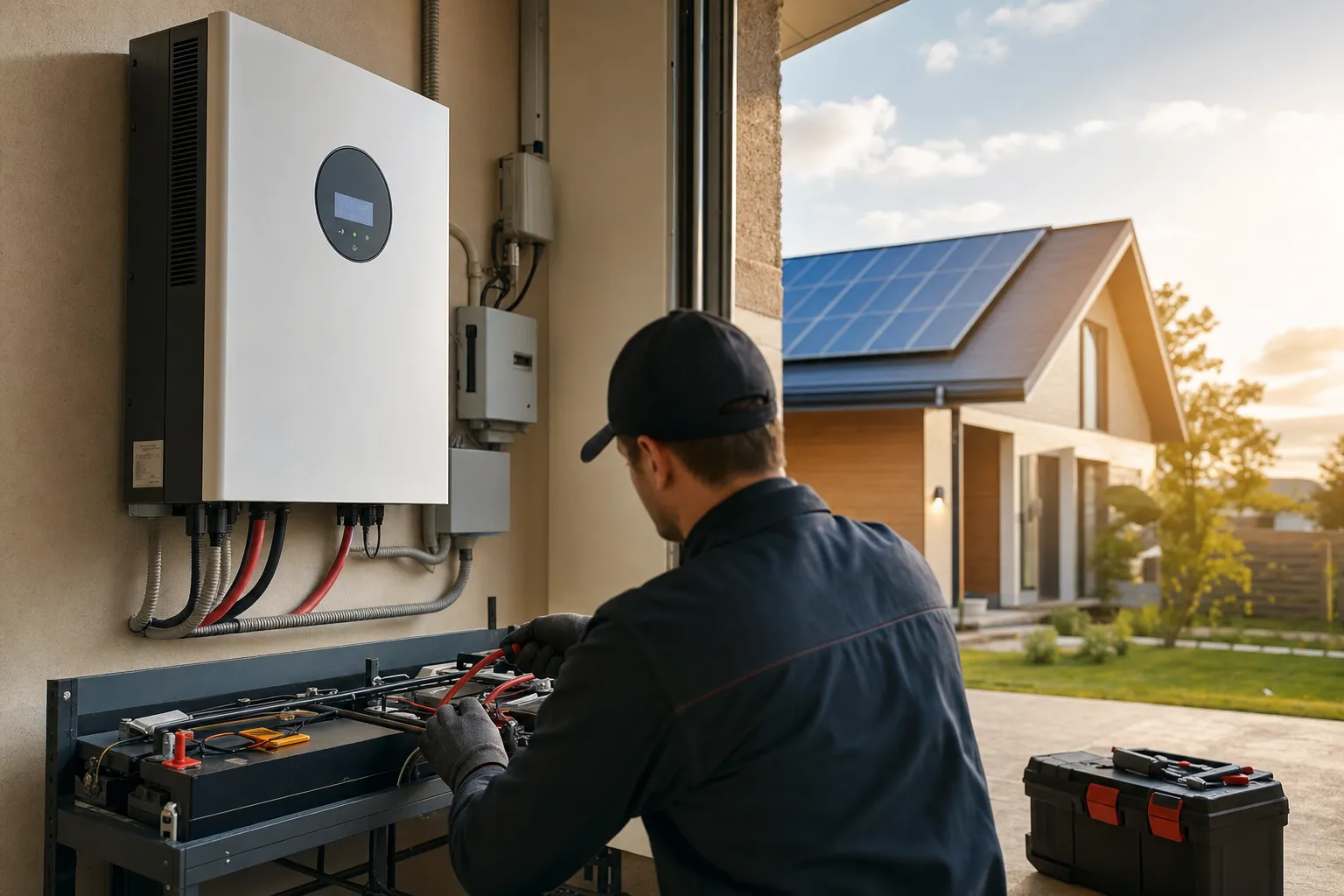
Battery Cable Size for Solar Inverters (12V/24V/48V): How to Choose Safely
Battery cable size for solar inverters explained with a safe, practical decision flow: estimate max amps, measure run length, manage voltage drop, and choose DC-rated protection.
Table of contents
Key takeaways Why inverter cables are different Step 1: Estimate maximum DC current Step 2: Measure the run (the part most people miss) Step 3: Set a practical voltage-drop target Step 4: Choose cable + lugs + protection as a system Why 24V/48V makes this easier Common mistakes FAQ Next logical reads
Key takeaways
- Battery-to-inverter cables are often the highest-current wires in a solar system.
- Longer runs and lower voltage (especially 12V) create voltage sag that can look like a “bad battery” or “bad inverter.”
- Good results come from sizing the whole chain: cable, lugs, fuse/breaker, disconnect, and terminations.
Solar wiring decisions (pillar hub) Solar wire size: choose the right gauge
Why inverter cables are different (and why mistakes get expensive)
Panel wiring is often higher voltage and lower current. Inverter battery cables are the opposite: low voltage and very high current. That’s why cable size changes so dramatically between 12V, 24V, and 48V systems.
Rule of thumb: high current + long distance = heat risk + voltage drop.

Step 1: Estimate maximum DC current (use the inverter’s specs)
Start with the inverter’s continuous power and think about whether your loads require surge (motor starts, compressors, pumps). Cable and protection decisions should be based on the maximum current the circuit can realistically see.
Convert inverter watts to battery amps
A simplified planning estimate is:
Battery amps ≈ Inverter watts ÷ Battery voltage
Real systems vary because battery voltage changes with state of charge and inverter efficiency. This estimate is still useful for deciding whether your wiring plan is in the right ballpark.
How to size an inverter (watts, surge, draw) 12V vs 24V vs 48V solar systems
Step 2: Measure the run (the part most people miss)
Measure the actual routing path, not the straight-line distance. Battery cables often need to route around compartments, through grommets, and around corners.
- Keep the run short whenever possible (especially at 12V).
- Count both conductors: positive and negative matter for voltage drop.
- Avoid loose routing where vibration can work terminations loose over time.
If you’re tempted to place the inverter “where it fits,” re-check the cable run first—layout is a wiring decision.
Step 3: Set a practical voltage-drop target (performance, not perfection)
Voltage drop on inverter cables isn’t just “lost efficiency.” It can change equipment behavior: voltage sag can trigger inverter alarms, shutdowns, and reduced surge capability.
A simple planning mindset is: keep voltage drop low enough that the inverter sees a stable battery voltage under load. If you’ve ever seen the inverter shut off even though the battery reads “fine” at rest, wiring voltage drop is a top suspect.
Low solar output troubleshooting (symptoms vs causes)
Step 4: Choose cable + lugs + protection as a system
Thick cable only helps if the terminations and protection hardware match. Many “mystery heat” problems are actually at the lugs, bus bars, or disconnect—not in the middle of the cable.
Cable selection checklist (planning-level)
- Conductor: copper is common for high-current inverter runs.
- Flexibility: pick a cable type you can route without stressing the lugs.
- Temperature + abrasion: protect against sharp edges and hot engine bays (where relevant).
Termination checklist
- Right lug size: lug barrel matches cable gauge; stud hole matches the terminal.
- Quality crimps: poor crimps act like resistors and create heat.
- Torque and re-check: high-current connections should be torqued to spec and inspected periodically.
Protection checklist
- Use DC-rated fuses/breakers/disconnects at the correct voltage rating for your system.
- Protection is typically chosen to protect the wire and the circuit, not to “protect the appliance.”
Solar fuses vs breakers (where each belongs) Wiring & protection cost (what’s included)
Why 24V or 48V usually makes battery cabling easier
For similar power, higher voltage means lower current. Lower current usually means smaller cables, less voltage drop, and less-expensive protection hardware.
This is one reason many systems “graduate” from 12V to 24V or 48V as inverter size and loads increase.
How to choose solar system voltage How to size a solar system (start-to-finish flow)
Common mistakes (and how to avoid them)
- Sizing from “average watts”: cables are stressed by peak current, not your daily average.
- Assuming surge doesn’t matter: it may not change the cable every time, but it often changes the safety margin.
- Long runs at 12V: this is a classic cause of voltage sag and low-voltage shutdown.
- Bad terminations: heat at lugs and bus bars is a symptom; fix the connection, not just the cable.
- Non-DC-rated hardware: DC interrupt ratings and voltage ratings matter for safety.
FAQ
Do I size inverter battery cables for surge or continuous watts?
Plan around the maximum current the circuit can realistically see. If you run motor loads or compressors, surge behavior can be relevant. Use the inverter specs and leave a conservative margin.
Why do 12V inverters need such thick cables?
At 12V, the same power requires more current than at 24V or 48V. High current drives thicker cable, larger lugs, and higher-rated protection.
My inverter shuts down under load—could it be cable size?
Yes. Voltage drop at high current can make the inverter see a “low battery” even if the battery is healthy. Check cable length, lug tightness, and signs of heating at connections.
Can I oversize battery cable?
Often, yes—oversizing reduces voltage drop and heating. The practical limits are cost, routing difficulty, and ensuring your lugs, disconnects, and bus bars are compatible.
Is it safe to use AC breakers on DC inverter circuits?
No. Use devices explicitly rated for DC at your system voltage. DC interrupt ratings are not interchangeable with AC ratings.
Next logical reads
Solar fuses vs breakers Solar wire size Wiring & protection cost Inverter sizing Choose system voltage

.jpg)